Author: Michael N. McGregor

  • Alone on Patmos: My First Self-Isolation Experience, 35 Years Ago

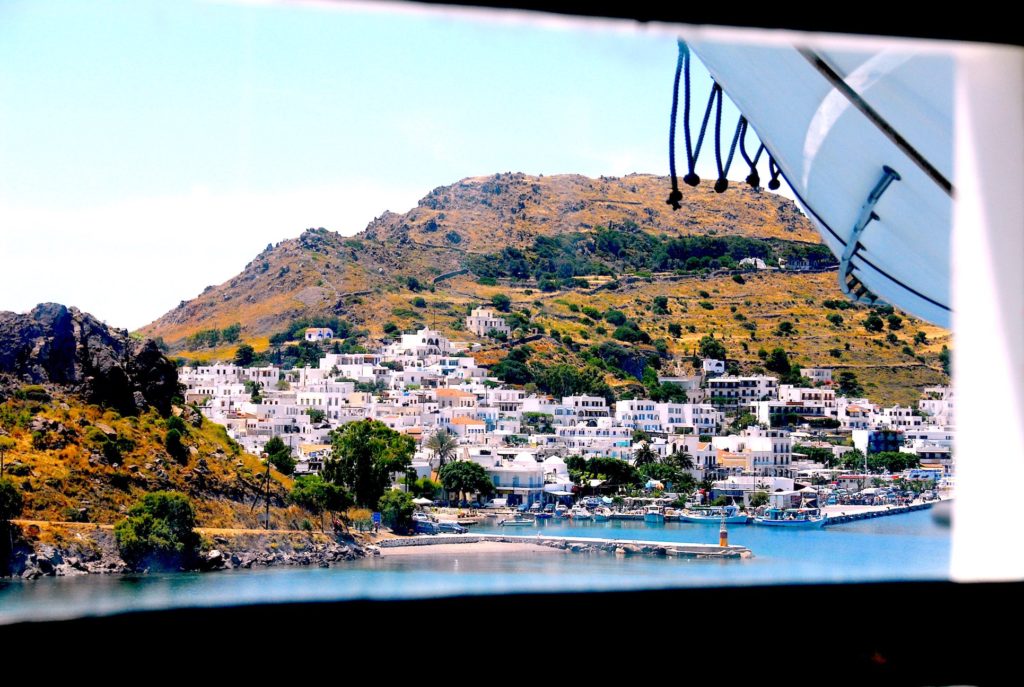
    View of the Patmos harbor in Skala from the ferry (© Michael N. McGregor)

    Thirty-five years ago, in a simpler and less-connected time, I had my first experience with self-isolating. After traveling through Europe with a friend, I caught the nine-hour ferry to the Greek island of Patmos by myself. I didn’t know anyone there. In fact, after my friend flew home, I didn’t know anyone within thousands of miles of where I was. There was no internet in those days, of course, and I was too poor to afford what was then the high cost of international calls. For the two months I planned to be on Patmos, I would have no contact, even by mail, with anyone I knew.

    I didn’t remember at the time that Patmos was where an earlier man, now a saint, had spent time in isolation. I chose it only because I had vowed to take the first ferry out whenever I was ready to go and it was the first stop. A Greek man told me it was beautiful—which it turned out to be, although it was January, when Patmos is swept by fierce wind and the temperature hovers near freezing.

    Broke and needing the cheapest possible place to stay, I managed to secure what was usually a summer-only apartment for just three dollars a day. It had two beds in a modest main room, a small kitchen, a tiny bathroom, and a balcony big enough for one person, with a view out over the fields to the distant sea. I couldn’t believe my luck—until a few hours later when I realized why it was a summer-only place: It was made entirely of concrete and had no heat.

    My main reason for secluding myself on an island in a country I’d never been to before was to set down the first draft of a novel. I was only 27 but I’d been a writer for over a decade and veered into journalism to support myself despite wanting to write fiction. Now I had my chance. I set strict rules for my island time. I had to type for at least eight hours a day before doing anything else. (I later amended that to six hours.) Thinking didn’t count; only the time my fingers were actually pecking away. I could go for walks but only after the day’s writing was done. The same was true of reading. The one exception was Sunday, which I took off as a day of rest.

    The only person I spoke to that first month, other than a brief word or two with my landlord, was an Australian woman who ran the closest grocery store, and my conversations with her never lasted more than a few minutes. When I walked, I walked alone, except for three stray dogs that seemed to take turns accompanying me along the shore road. I thought of them as angels sent to keep me company. No matter when I walked, even near midnight, one would appear and amble beside me. Never more than one and never in a way that disrupted my thinking. They never begged for my attention and I never petted them. When our walk ended, they simply peeled off and headed home.

    The Monastery of St. John the Theologian on Patmos (© Michael N. McGregor)

    When I went to bed at night, warmed only by several thin blankets—or, later, when the sneezing and shivering made me to beg my landlord for some kind of heat, a cheap aluminum heater—I usually lay awake for a while. Because my nighttime thoughts were uninterrupted, I often woke up the next morning not knowing whether something I remembered had been a conscious thought or a dream.

    Sometimes during these nighttime reveries, I’d return to some place in my past. Free of present concerns, I was astonished at how well I remembered things, including, one night, my grandparents’ house, where I had lived for a summer as a small child and visited regularly until my grandfather died when I was ten. I found I could walk through the house and remember everything, even photographs hidden from view behind doors. I remembered the smell of the rusted screen on the open window in the attic room where I slept on the floor—the Dr. Seuss books stacked beside me and my grandparents’ winter clothes zipped into bags beyond the half-wall. I remembered that the bathroom wallpaper was black but full of colorful dots. I remembered my grandfather’s tools above the worktable at the bottom of the basement stairs, the perennial five-gallon tub of vanilla ice cream kept in the freezer there, and the back room I liked to play in alone, where they stored their extra furniture: a room-sized collection of various forts.

    When I wasn’t thinking about my novel or remembering earlier times, I was praying for people I knew, imagining what they were doing. I missed them, of course, but in a strange way I felt closer to them through my thoughts and prayers than I do now when I can email anyone anywhere anytime.

    I’m sure I felt lonely at times, but I don’t remember feeling that way, other than on those nightly walks when I passed a small restaurant or bar where men (always men) watched movies at night, most of them Kung Fu movies. It wasn’t that I wanted to watch the movies or even be with those men, but the interior was softly lit and looked like a warm, pleasant space to sit with a beer in hand. Alcohol was one of the things I gave up during my self-imposed isolation.

    I had a Walkman with me and in the evening I’d often play one of the half-dozen cassette tapes I’d brought along. I had maybe a dozen books too, and I spent part of every evening reading. One book was Thomas Merton’s autobiography, The Seven-Storey Mountain, which I had bought in an Athens bookstore for little more than a dollar.  It was there, during that month of self-isolation that I read about and felt a strong attraction to the Merton friend I would eventually come to know and write a biography of: Robert Lax.

    In addition to my cassettes and books, I had small packages of modeling clay and, though I’d never studied sculpting, I managed to form what looked like the face of an ancient Greek man and a bum sitting with his dog on a curb, reflective of a character in the novel I was writing. (I almost destroyed this last one by trying to “fire” it on the gas stove, rescuing it just in time, with only some singeing on the bottom.)

    On my Sunday walks, if it wasn’t raining, I roamed farther and farther over the island, eventually choosing the wilder places where there was only a thin trail. At first I looked for the snakes I’d read warmed themselves on Greek island trails, but since it was never warm and I never saw wildlife of any kind except birds, I stopped looking.

    One of my favorite places to go, rain or shine, was a huge rock connected by a narrow causeway to one of the beaches far from town. A small guidebook a man in a shop gave me said the caves carved into it had been used by monks living in stricter isolation centuries ago. By the time I started exploring the caves, the only signs of previous habitation were the smells and droppings of goats, but I did find a crude catchment tank for rain water at the top. What I liked most about the cave I usually sat in was that all I could see from it was the sea. Sitting there, although I had never had any instruction in playing it, I would sound out tunes on my harmonica: childhood songs, spirituals, and simple hymns.

    When my mother’s birthday neared, I went around to all of my favorite places and recorded the sounds for her: the ocean rolling the beach pebbles, the goat-herder’s cry, the tinkle of goat bells, the thunder that shook my apartment when a big storm passed, and my halting, inept playing of “Happy Birthday” in that cave. Then I sent it off, hoping it would arrive in time.

    When I had been on the island a month, it wasn’t the isolation but rather the cold that got to me. Somewhat miraculously, I’d finished a full draft of my novel by then. I decided to take the ferry back to Athens, check into a hotel with heat for a while, and send a copy of the novel home for safekeeping. I planned to visit some of the ancient sites as well: Corinth, Olympia, Delphi.

    In those moments before I left the island, I felt as centered and open and peaceful as I ever had. It was then, as I waited for a ferry delayed by winter weather—as I thought about going back to my room and trying again the next night—that I heard a voice for the only time in my life. “If you will endure,” it said, sounding inside me, “God will bless you.”

    Moments later, the delayed ferry appeared, and as I boarded it, I fell into conversation with an older man. It was during our brief interaction that I found out Robert Lax was living on the same island I was. This news seemed miraculous, of course. A revelation. A blessing. Born of the isolation I had dared to endure and the peace that had come to me through it.

    (To read what happened when I met Robert Lax a few days later, see my book: Pure Act: The Uncommon Life of Robert Lax, which includes the story of our friendship.)

  • FDR on a President’s Priorities in a Democracy

    FDR Presidential Library & Museum photograph by Margaret Suckley [CC BY (https://creativecommons.org/licenses/by/2.0)]

    I haven’t added a new post to this site in a long time, and I’m not going to promise to be consistent about adding posts now. But I’ve started working on a new project, centered in the first decades of the 20th century, and some of what I’m reading for it is worth posting about because it relates to what we’re living through in the US today.

    I’ll try to say more about what I mean by that in future entries, but for now, just to get started, I’m going to simply post a quote about FDR from a book published in 1937, when his policies were showing some signs of working but the Depression was far from over. The book deals primarily with his policy toward electricity and public utilities in general.

    Here’s the quote:

    “The President’s thinking goes first to government–democratic government–and after that to economics…In the prodigies of effort he put forth to lead the country out of the bogs of depression he therefore sought, and seeks still, more than what he has termed ‘a purposeless whirring of machinery.’ It is important that every man have a job, that every factory have orders to fill and that business as a whole earn profits. ‘But,’ as he said in his annual message to Congress in January, 1937, ‘government in a democratic nation does not exist solely, or even primarily, for that purpose.’ The factory wheels ‘must carry us in the direction of a greater satisfaction in life for the average man. The deeper purpose of democratic government is to assist as many of its citizens as possible–especially those who need it most–to improve their conditions of life, to retain all personal liberty which does not adversely affect their neighbors, and to pursue the happiness which comes with security and an opportunity for recreation and culture.’”

    pp. 292-293, Pyramids of Power, M. L. Ramsay

  • An 11-Year-Old’s Memories of the First Moon Walk

    I know exactly where I was 50 years ago tonight: at Camp Parsons, a summer camp run by the Boy Scouts on Hood Canal in Washington State. The night did not start out well. I was assigned KP duty for dinner, the duty no one wanted. I can remember as clearly as if it were yesterday standing in the industrial-looking kitchen holding a large metal pot with mashed potato remains clinging to it. When I asked whoever was supervising me how I should clean it out, he grabbed my hand and thrust it into the cold, disgusting remains. I hated him instantly, of course, and that feeling hadn’t dissipated when I was finally released to go back to the tent I was staying in.

    It was late by then and I was crossing the camp alone when I heard a loud cheer come out of one of the counselors’ cabins. The door was ajar and I inched that way to see what was happening. One of the counselors saw me and told me to come in—and there, on a small black-and-white television was the grainy image (shown here) of a man in a white space suit. It was Neil Armstrong, who had just taken his first step onto the moon. There, in the doorway to that cabin, while all of the other campers were sleeping or reading or playing around, the eleven-year-old me watched those first minutes men walked on the moon and heard their words about coming in peace.

    I had been a huge space fan for years already. In addition to building a model of the Gemini capsule, I had checked out books at the library on the history of rockets and space flight. I’m sure I was terribly disappointed when I learned that I would be at camp, without a television, when the moon landing happened. But it all worked out. What could have been better, in fact, than walking out into that dark camp afterward, looking up at the moon without the lights of a city around me, and thinking: There are men up there, right now. Of course, the moon would never look quite the same after that—to me or to anyone else.

  • What It Means to Make Art

    What It Means to Make Art

    A man in Germany (Jörg Kowalski) who reads my bimonthly Robert Lax Newsletter (you can sign up at robertlax.com) sent me a note and a book recently. The note told of his trip to Patmos to follow in Lax’s footsteps, and the book contained his poetry, some influenced by Lax’s work.

    The back of the poetry book had only the words pictured here on it. I can’t think of a better (or more succinct) definition of being an artist; of why one makes art.

    For those who don’t know German, here’s a translation:

    now I see
    what you don’t see
    and that is me

  • Three Thoughts About…Rejection

    Three Thoughts About…Rejection

    The reason I and many other older writers and writing teachers advise young would-be writers to do something else unless they feel absolutely driven to be a writer is that being a writer can be extremely hard. It rarely pays enough to live on and there’s no guarantee that, however hard you work, you’ll ever succeed. In fact, given the vagaries of the writing and reading world, the odds are against you.

    The hardest part of being a writer, though, at least a career writer, is the emotional side. Every writer has faced rejection of her work, and all but the most commercially successful writers face it again and again, even after they’ve achieved a fair amount of publishing success.

    Rejection of any kind is hard on anyone. What makes the rejection a writer (or any artist) experiences even harder is that the work she does, she does alone, usually for hours on end. It is emotionally taxing just to muster the belief in yourself and the work you’re doing to return to the desk day after day, creating something at the outer edges of your abilities without any insurance that anyone else will see its value. But once you’ve finished it—or think you might have finished it—subjecting it to the opinions of often-distracted and almost-always-overworked editors or agents is more taxing still.

    So how does a writer navigate rejection and keep writing? Here are three thoughts:

    1. Rather than submitting your finished work immediately to magazines or an agent, cultivate a circle of smart writing friends who will give you their honest opinion on it first. If you can, join or form a regular writing critique group. Make sure the group members are dedicated and at a relatively similar place in their writing development.

    2. When you finally submit, do so on a tiered basis, sending out to the places you’d most like to be published first, and then, when the inevitable rejections come back, sending to the next tier down and then the next and the next. Every time a rejection comes in, send your piece out to the next place on your list right away so you always have things in circulation, always have a reason to hope.

    3. Pay attention to any comments editors might give, since most don’t do more than send a form rejection anymore. Comments mean you’ve caught their attention. But don’t put too much stock in rejection of any kind, with or without comments. The best thing about rejection is it clarifies your intentions, helping you see if you’re writing because you feel a deep need to write or writing only for the supposed reward of seeing what you’ve written in print. Of course every writer wants to see what he has written be published and read, but the most important thing is to write what you have to write rather than trying to write what you think someone will publish.

    Welcome rejection. It is a sign that you have taken the risk of sending your work out, giving it a chance to find its place in the world. The more rejections you experience, the less any one will bother you. If you persevere, rejection builds fortitude. And, if nothing else, it means one more person has read your writing. 🙂

  • Three Thoughts About…Teaching

    I have been teaching writing for over 25 years, and during my 17 years in Portland State University’s creative writing program, the students chose me to receive the English department’s John Eliot Allen Outstanding Teacher Award five times–almost every year I was eligible. (You had to sit out two years each time you won it.) I mention this only to suggest I know a little bit about teaching writing. Or maybe just teaching in general.

    Whenever I received one of the Allen awards, people would ask me the secret to good teaching. My answer was always that you have to love your students, caring about them as individuals. Beyond that, every teacher has to teach in her own way, according to her own personality and vision. Here are three basic principles that have worked for me:

    1. Challenge students to achieve beyond what they think they’re capable of doing by setting high goals and high standards.
    2. Actively and persistently help each student to achieve those goals and maintain those standards, without relenting.
    3. Work harder than your students work.

    And one more thing: Encourage your students in every possible way at every possible moment.

    The most consistent thing students have said about my teaching is that I’m tough but fair. If you aren’t tough, you aren’t helping students do anything more than they could do on their own, in which case they don’t need a teacher. If you aren’t fair, they’re going to stop listening to you no matter how right you are about what you’re trying to teach them.

  • Teaching a Nonfiction Writing Seminar in NY June 17-21

    Teaching a Nonfiction Writing Seminar in NY June 17-21

    For the third year in a row, I’ll be part of the excellent creative writing faculty at the Manhattanville College MFA Summer Writers’ Week. Taking place June 17-21, the program offers workshops every morning, craft and publishing seminars every afternoon, and readings every evening. It’s an awesome week.

    This year’s featured writer is novelist Hannah Tinti, who will be teaching the fiction workshop. The wonderful Melissa Tuckey will be back to teach the poetry workshop and the talented Sharbari Ahmed returns to teach dramatic writing.

    Registration is $750 and for a mere $200 more, you can stay in a single room in a suite in the dorms. Manhattanville is in Purchase, NY, just half an hour from New York City, making it easy to add a couple of days in Manhattan on either end.

    Go to the Summer Writers’ Week website for full details.

  • Three Thoughts About…Symbols

    Three Thoughts About…Symbols

    1. A symbol is an object or action invested with greater significance than it would have if taken only at face value. Pearls, for example, are simply bits of organic residue left by an oyster. Because we prize them for their beauty and rarity, however, they can become potent symbols in a story. A poor woman’s refusal to sell a string of heirloom pearls inherited from her mother might symbolize: her love for her dead parent, her pride in her family of origin, the feeling of dignity she derives from her ancestry, or her unwillingness to give up hope of a better life. If she becomes so desperate for food or shelter or love she considers selling the pearls, their symbolic value helps us understand just how deep her desperation is.

    2. A symbol is often used to: a. highlight an important aspect of a particular character; b. focus the reader’s attention on some particular part of a story; c. point to a greater possible meaning.

    3. One of the dangers of symbols is they can become easy shorthand for ideas and especially emotions that should be developed more fully and organically in a story. Sentimentality relies heavily on symbols to create what some call “unearned emotion.” So does melodrama. And politics. Symbols misused in this way include: American flags, babies, suffering animals, and racist caricatures (such as the infamous Willie Horton ad used by the George H. W. Bush presidential campaign).

    Since this is the first in my series of entries about different aspects of writing and being a writer, here’s a bonus thought:

    Many short stories are built around the central symbol in their titles. Oft-anthologies examples include: William Faulkner’s The Bear, Cynthia Ozick’s The Shawl, Louise Erdrich’s The Red Convertible, Guy de Maupassant’s The Necklace, Tillie Olsen’s I Stand Here Ironing, John Cheever’s The Swimmer, D. H. Lawrence’s The Rocking-Horse Winner, Charlotte Perkins Gilman’s The Yellow Wallpaper, and Edgar Allan Poe’s The Cask of Amontillado.

  • Announcing a New Series of Posts about Writing and Being a Writer

    Announcing a New Series of Posts about Writing and Being a Writer

    Just over a year ago, I took early retirement after 20+ years of teaching writing at the college level to focus on my own work. Most of those years I taught literary nonfiction or fiction to both graduate and undergraduate students. The students at my last school, Portland State University, honored my efforts by voting me the English department’s Outstanding Teacher five times in 17 years, almost every year I was eligible.

    I continue to work with individual writers and teach in summer programs at the Collegeville Institute in Minnesota and the Manhattanville College MFA’s Summer Writers’ Week, but I no longer have regular, year-long exposure to students. So, before I forget all I talked about in those classes, I’ve started writing a book about writing and being a writer.

    As I work on the book, I’m going to be posting a series of short meditations on different aspects of both writing and living as a writer, to be called Three Thoughts About… The thoughts in the individual entries might be formal or informal, technical or creative, practical or whimsical. I’m hoping mostly just to have fun with them and share some of what I’ve learned in my decades of both teaching and writing.

    To see the many kinds of writing I’ve done myself, click on the About link above. And please let me know what you think of my Three Thoughts About… entries or, better yet, share them with others by linking to them on social media or your own website.

  • Great New Books for Your Reading List!

    Every year around this time, it seems, friends, acquaintances and former students publish a bunch of wonderful books. To help get the word out and give you some reading ideas, here are brief descriptions and links:

    1. TWO of the best books of ROBERT LAX‘s poetry are being reissued in paperback after many years of being impossible to find for a reasonable price:

    33 POEMS (my favorite Lax collection), New Directions–out today!

    LOVE HAD A COMPASS, Grove Press. This one came out last week.

    2. THE ATLAS OF REDS AND BLUES by my grad school classmate Devi S Laskar, Counterpoint Press. This chilling and deeply personal novel shows the ramifications of racism in this country. It has been praised everywhere. Published in early February.

    3. MOTHER WINTER by my former student Sophia Shalmiyev, Simon & Schuster. Another book being lauded all over, this one is a feminist memoir about Sophia’s harrowing early childhood and the move to America that meant leaving her troubled mother behind. It’s also about becoming a mother herself. Released two weeks ago.

    4. SURVIVAL MATH by another former student of mine, Mitchell S. Jackson, Scribner. In this memoir/social investigation, Mitchell looks at the various members of his African-American family and the different ways they dealt with and were affected by the poverty, violence, drugs–and community and love–in his North Portland neighborhood. This one doesn’t come out until March 5 but it’s already receiving all kinds of press.
    (If you haven’t read Mitchell’s prize-winning novel, The Residue Years with a similar theme, do that too!)

    5. THE GOSPEL OF TREES by yet another former student, Apricot Anderson Irving, Simon & Schuster. I wrote last winter about this beautiful memoir of growing up in a missionary family in Haiti and the questions about faith, cross-cultural interactions and one’s own place in the world it addresses. I’m including it this year because the paperback comes out March 26.

    6. HALF THE CHILD by another grad school classmate, William J. McGee, William J. McGee. This novel takes you inside the relationship and struggles of a divorcing dad and his toddler son–a rare, compassionate view. Already available.

    7. PLACEMAKER: CULTIVATING PLACES OF COMFORT, BEAUTY, AND PEACE by Christie Purifoy, Zondervan. I worked with Christie during one of my Collegeville Institute writing weeks. Starting from her restoration of a Pennsylvania farmhouse and the idea that we are all gardeners in one way or another, Christie writes about the need to create and live within beauty. Comes out on March 12.

    8. CONFESSIONS OF A BAREFACED WOMAN by Allison Joseph, Red Hen Press. Allison was my colleague at Southern Illinois University two decades ago and has sent many beautiful poetry books into the world since then. This is one of her most personal, “highlighting in turns light-hearted and harsh realities of modern black womanhood” (says the Amazon description).

    9. LOSING MY RELIGION by William Mills, Resource Publications. I worked with Bill at Collegeville too. This is his story of taking over as the priest at an American Orthodox congregation and the chaos that ensued.

    10. INHERITANCE by Dani Shapiro, Knopf. I taught with Dani in the Manhattanville College MFA Summer Writers’ Week last year. If you’ve been paying attention, you probably know about this memoir of learning through DNA testing that her father wasn’t her biological father and the upset that caused in the life Dani had made for herself. It came out in mid-January and has become a bestseller already.

    11. REAL DAUGHTER by Lynn Otto, Unicorn Press. Lynn was in the poetry program at PSU but took a couple of classes from me and has become a good friend. I heard her read from the book and it is lovely. You can hear her read poems from it yourself here: https://player.fm/…/flash-briefing-lynn-otto-reads-yolked-f…

    12. SEARCHING FOR SYLVIE LEE by Jean Kwok, William Morrow. Jean was my classmate in the MFA program at Columbia. This novel doesn’t come out until June 4 but it is already receiving HUGE press, including appearing on many “most anticipated” lists. It looks amazing.

    13. I AM A STRANGER HERE MYSELF by my former colleague in the nonfiction program at PSU, Debra Gwartney, University of New Mexico Press. It comes out March 1. This book won last year’s River Teeth Literary Nonfiction Prize. I’ve read excerpts and it’s wonderful. It’s a researched meditation on Narcissa Whitman, the first white woman in the Northwest, and a memoir of the strong women in Debra’s family, who have lived in the NW for generations. (If you haven’t read Debra’s last memoir, the popular and intense Live Through This, go get that one too!)